


VIRGIL MURDER
AN IMPERIAL SNAKE (Ov. Met. 3. 131-137) [*]
by Jean-Yves Maleuvre
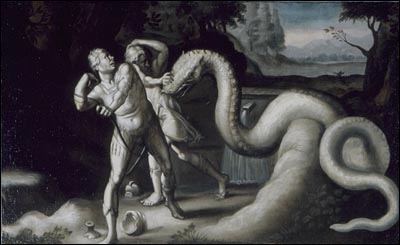 At the beginning
of the third book of his Metamorphoses, Ovid relates how the young Tyrian
hero Cadmus was ordered by his father Agenor to search Europa rapted by Jupiter
under the appearance of a white bull, how he wandered the world to no avail, and
how he eventually founded the city of Thebes after killing a monstrous serpent
that had attacked his men. But suddenly the poet, using a striking temporal
ellipsis, addresses an aged Cadmus with these words (Met. 3. 131-137) :
At the beginning
of the third book of his Metamorphoses, Ovid relates how the young Tyrian
hero Cadmus was ordered by his father Agenor to search Europa rapted by Jupiter
under the appearance of a white bull, how he wandered the world to no avail, and
how he eventually founded the city of Thebes after killing a monstrous serpent
that had attacked his men. But suddenly the poet, using a striking temporal
ellipsis, addresses an aged Cadmus with these words (Met. 3. 131-137) :
Iam stabant Thebae, poteras iam, Cadme, uideri
exilio felix ; soceri tibi Marsque Venusque
contigerant ; huc adde genus de coniuge tanta,
tot natas natosque et, pignora cara, nepotes,
hos quoque iam iuuenes ; sed scilicet ultima semper
exspectanda dies homini est, dicique beatus
ante obitum nemo supremaque funera debet.
'When Thebes at length stood firm, one might have guessed
That Cadmus in his banishment was blessed :
Happy, with child of Mars and Venus wed ;
Happy, with children of such mother bred ;
In sons and daughters did his race endure,
With grandsons tall to make succession sure.
But wise the word : 'Await the end : let none
Be counted happy till his days are done." [1]
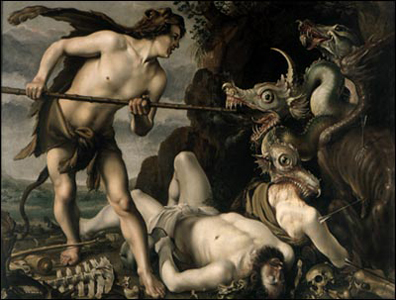 Cadmus was so
certain of his definitive happiness, and so infatuated by his continual success,
that he had forgotten the terrible prophecy that, years before, a mysterious Vox
had made to him : 'You will be a serpent'. So the poet reminds him of king
Croesus, who believed himself to be the happiest of men, until the wise Solon
advised him to wait for his last day before calling himself happy
[2].
In which tone and to which purpose?
Cadmus was so
certain of his definitive happiness, and so infatuated by his continual success,
that he had forgotten the terrible prophecy that, years before, a mysterious Vox
had made to him : 'You will be a serpent'. So the poet reminds him of king
Croesus, who believed himself to be the happiest of men, until the wise Solon
advised him to wait for his last day before calling himself happy
[2].
In which tone and to which purpose?
It could seem at first sight that the poet is sympathizing with his character, but this interpretation largely depends on the meaning of the verb uideri. Understood, as usual, in the sense of 'seem to', 'be considered', it gives the impression that Ovid really admires Cadmus' happiness, and that scilicet ... semper expresses a kind of bitterness, or even of revolt, against the frailty of human condition. But the evocation of king Croesus should rather favour the sense of 'believe himself', which is also more coherent with the fact that huc adde addresses Cadmus (see tibi, 132), and not the reader. It is as if Ovid surreptitiously slipped into the hero's mind and mimed his presumptuousness and his hybris. Then, all of a sudden (sed scilicet) he faces him, and solemnly gives voice to the divine law (debet).
But this carefully veiled hostility that animates the poet against the founder of Thebes finds in these same lines an other and no less subtile expression through the use of intertextuality [3]. Their theme, tone and language are indeed reminiscent, though discreetly so, of Cat. carmen 23. In that poem, Catullus pretends to marvel at the miraculous felicity of Furius, before harshly rebuking him for soliciting money from everybody. The phrase hanc ad munditiem adde mundiorem, 18 is echoed here by huc adde, and the exclamative tam, 24 by tot, while the polyptotic beate ... beata ... beatus, 15, 24, 27 is transposed in felix ... beatus. But above all, the familial pride of Cadmus is put in parallel with that of Furius through the echoing of coniuge tanta to the Catullan cum coniuge lignea, 6, a fact that tends to confirm the assumption that in carmen 23 coniuge points to (a statue of) a dea, (just as here Harmonia is a dea), for instance Juno, with the consequence that Furius could mask Julius Caesar [4].
 So
Ovid sheds light on Catullus, who in return helps the reader to unmask Cadmus
[5],
a necessary task, insofar as the secret malevolence of the poet's against a
purely imaginary figure needs a justification. After all, you write always for
your contemporaries, Ovid
being
no exception to the rule
[6].
It is well known that the mythical Thebes offered to would-be dissidents a
convenient projection of the Roman reality
[7],
and Ovid would have had no reason to conceal his hostility against Cadmus if no
retaliation had been to fear. Of course, the anagram of OCTAVIVS CAESAR under
pOTERAS IAm CAdmVS may be purely coincidental, but one must admit that the
enviable situation of Cadmus neatly parallels that of Augustus in the year 2 B.
C., as described by R. Syme in his classical book on 'The Roman Revolution'
[8].
So
Ovid sheds light on Catullus, who in return helps the reader to unmask Cadmus
[5],
a necessary task, insofar as the secret malevolence of the poet's against a
purely imaginary figure needs a justification. After all, you write always for
your contemporaries, Ovid
being
no exception to the rule
[6].
It is well known that the mythical Thebes offered to would-be dissidents a
convenient projection of the Roman reality
[7],
and Ovid would have had no reason to conceal his hostility against Cadmus if no
retaliation had been to fear. Of course, the anagram of OCTAVIVS CAESAR under
pOTERAS IAm CAdmVS may be purely coincidental, but one must admit that the
enviable situation of Cadmus neatly parallels that of Augustus in the year 2 B.
C., as described by R. Syme in his classical book on 'The Roman Revolution'
[8].
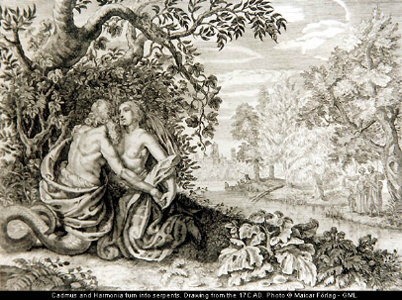
The transformation of Cadmus and his wife in snakes eventually occurs in the fourth Book of Metamorphoses (lines 569-603). But, why is this particular metamorphosis so interminable [9], so farcical, and so repellent at the same time ? Perhaps we have now the answer, and we may laugh.
[*] This note is an extract from my just finished book on Vrais et faux héros dans les Métamorphoses d'Ovide, soon, as I hope, to be published. I would like to thank Mrs M. T. Griffin for her aid and assistance on the translation.
[1] This is the translation offered by B. Otis, in his famous book Ovid as an epic poet (2d ed. 1970).
[2] Herod. Hist. 1, 32. But cf. also Esch. Ag. 928, Soph. Oed. Rex 1528-30, Eur. Andr. 100.
[3] I could find nothing neither in F. Bömer nor in W. S. Anderson about the influence on the concerned lines of Cat. c. 23. The mocking tone of the phrase huc adde is confirmed by the echo (pointed out by Bömer) to adde huc of Cat. c. 58a, 5.
[4] My hypothesis is that Furius (alias Julius Caesar) is satirized by Catullus for having his statues in temples, exactly between his 'father' Jupiter and his 'stepmother'(nouerca, 3 ; coniuge ... parentis, 6) Juno (his 'mother' being of course Venus) : cf. J.-Y. Maleuvre, Catulle ou l'anti-César (Paris, 1998), 161-8.
[5] This is an interesting example of what J. Booth has called, in a different context, 'intertextual illumination' : cf. J. Booth, 'Moonshine : intertextual illumination in Propertius 1. 3. 31-33 and Philodemus, Anth. Pal. 5. 123', CQ 51 (2001), 537-44.
[6] Cf. U. Schmitzer's pioneering book on Zeitgeschichte in Ovids Metamorphosen : mythologische Dichtung unter politischem Anspruch (Stuttgart, 1990).
[7] Cf. P. Hardie, 'Ovid's Theban history : the first "anti-Aeneid" ?', CQ 40 (1990), 225, 229-30.
[8] 'Fortuna made a mock of Caesar Augustus before 2 B. C. ended, the year he designated for solemn and joyous pageantry', writes R. Syme in The Roman Revolution (1939) ; and cf. Pline, N.H. 7. 149 : iuncta deinde tot mala. U. Schmitzer, op. cit. 144 ff., identifies likewise Cadmus, but 'als positiver', to the Roman emperor.
[9] The paradoxical subito, 600 ironically underlines this prolixity. Compare the fourteen lines devoted to the metamorphosis of Philemon and Baucis (8. 711-724) : sobriety and sublime go hand in hand.